
What Are China Top 10 AGV Technology Manufacturers?

China’s automated logistics sector is moving from pilot projects to dense, measurable operations. In factories, small mobile robots now travel between storage racks, production lines, and loading stations. This shift makes Agv Technology a strategic capability, not merely a purchasing option.

The International Federation of Robotics reported 276,288 industrial robots installed in China during 2023. That represented more than half of global installations. Its World Robotics 2024 report also identified transportation and logistics as leading professional service robot applications. Interact Analysis has likewise documented strong growth in warehouse mobile robots, supported by e-commerce, manufacturing, and labor shortages. These figures provide useful context, although AGV data is often grouped with AMRs.

The distinction matters.

This guide examines China’s top 10 AGV Technology manufacturers through practical and verifiable criteria. These include navigation accuracy, payload capacity, fleet-management software, battery performance, safety certification, system integration, and after-sales support. A robot that performs well in a showroom may struggle beside a crowded packing line. Floor markings fade. Wi-Fi drops. Pallets arrive unevenly.

Company scale and public reputation also influence the evaluation. However, rankings are never perfectly objective. Some manufacturers disclose detailed test results, while others publish limited performance data. Therefore, readers should treat this list as a research starting point, not a final purchasing decision. Supplier audits, site trials, maintenance records, and total-cost analysis remain essential before deployment.
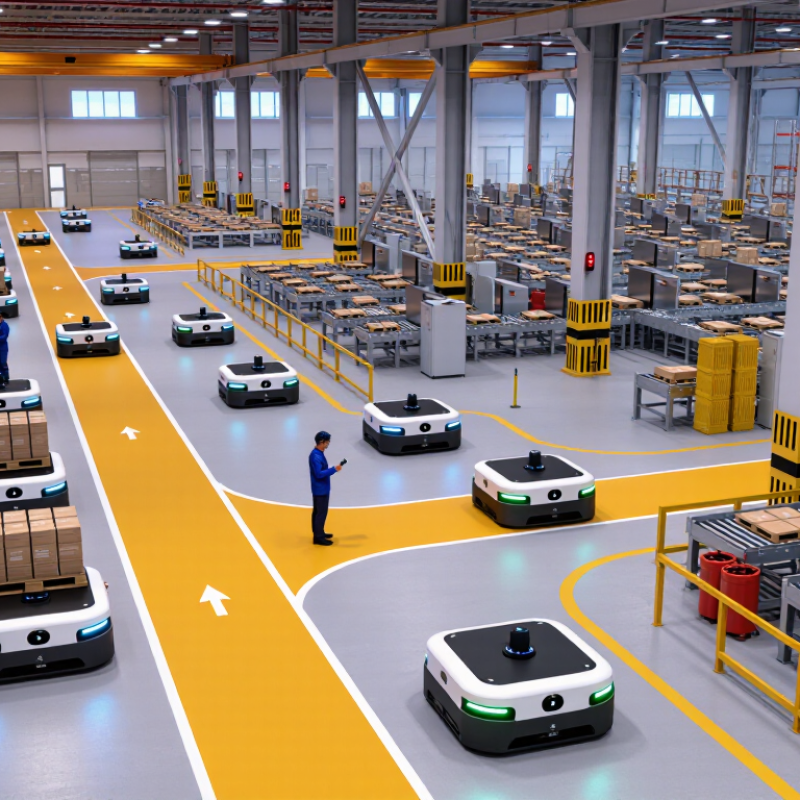
What Are China Top 10 AGV Technology Manufacturers?

What Are AGVs and How Do They Support Modern Industrial Automation?

Automated Guided Vehicles, or AGVs, are mobile machines that transport materials without a human driver. They follow magnetic strips, reflective markers, mapped routes, or sensor-based navigation. In a warehouse, an AGV may carry a pallet from receiving to a storage lane, then return for another load. It sounds simple. It is not.

Modern factories connect AGVs with warehouse software, production systems, elevators, doors, and robotic stations. Fleet control assigns routes, manages charging, and reduces traffic at narrow intersections. Safety scanners detect workers, carts, and unexpected obstacles. A well-designed system can improve delivery accuracy, reduce repetitive lifting, and provide useful movement data. Operators can inspect travel time, battery use, idle periods, and missed tasks.

Real installations still demand careful judgment. Floor damage, poor lighting, wireless interruptions, and changing work areas can reduce performance. A vehicle that works perfectly during testing may hesitate beside a crowded packing line. That gap matters. Engineers should test peak-hour traffic, emergency stops, load stability, and recovery after communication loss. Human training also matters, because workers may cross routes informally. AGVs support automation best when process design, safety review, maintenance planning, and measurable operating targets develop together. Some assumptions will be wrong. Regular review is necessary.


How Were China’s Top 10 AGV Technology Manufacturers Selected?

Selecting China’s top ten AGV technology manufacturers requires more than counting sales or online mentions. The evaluation begins with verified engineering experience. We examine fleet deployments, vehicle stability, navigation accuracy, payload performance, and operation in real warehouse conditions. Public product claims are checked against technical documents, customer evidence, and independent industry records.

The selection also considers software capability. Strong manufacturers should support warehouse management integration, traffic control, mapping, and remote diagnostics. Safety receives equal attention, including obstacle detection, emergency stopping, battery protection, and compliance with applicable standards. We review research activity, patents, testing facilities, production consistency, and after-sales service. Service matters greatly. A reliable response team can reduce downtime when a vehicle stops beside a loading station.

Evidence must be recent and comparable. We use a weighted assessment rather than one impressive project. Manufacturing scale receives less value when product quality varies between batches. Market visibility is considered, but it cannot replace technical proof. Interviews with engineers, integrators, and end users help reveal practical strengths and recurring faults. Some information remains difficult to verify. No ranking is perfect. A limited sample may overlook smaller specialists with excellent niche solutions. For that reason, the list is treated as a research-based reference, not an absolute judgment. Performance should be reassessed as technology, regulations, and customer requirements change.

How Were China’s Top 10 AGV Technology Manufacturers Selected?

This 100-point editorial framework evaluates manufacturers by the factors most relevant to industrial AGV technology purchasing decisions: navigation capability, system integration, safety compliance, fleet-management software, deployment experience, customization, and after-sales support. It is a methodology chart and does not display company or brand performance data.

Who Are China’s Top 10 AGV Technology Manufacturers?

China’s top 10 AGV technology manufacturers are best assessed by engineering depth, deployment records, and after-sales capability. The leading group includes two warehouse automation specialists, two factory logistics integrators, two mobile robot developers, one heavy-load vehicle maker, one vision-guided equipment producer, one software-focused supplier, and one customized system builder.

The first two excel in pallet movement and dense storage operations. Their AGVs often use laser navigation, safety scanners, and fleet scheduling software. The next two focus on production lines, where vehicles deliver components beside workers. Two mobile robot manufacturers provide flexible navigation for changing routes. One heavy-load producer serves factories handling steel coils or large molds. Another combines cameras with navigation for narrow aisles. The software-focused manufacturer connects AGVs with warehouse systems and production databases. The final customized builder adapts vehicles for unusual floors, payloads, and turning spaces.

Real projects reveal important differences. A reliable supplier tests braking distance, battery cycles, and wireless stability under real workloads. Site acceptance should include blocked paths and emergency stops. These details matter.

However, ranking China’s top ten manufacturers is not completely straightforward. Public performance figures are often inconsistent, and some suppliers report pilot results as standard capability. I would verify installation references, maintenance response times, spare-parts access, and local technician coverage. One impressive demonstration is not enough. Floors may be uneven. Software may need more tuning than expected. That is where practical experience can challenge a polished sales presentation.

What Core Technologies and Solutions Do These Manufacturers Provide?

China’s top AGV technology manufacturers develop more than driverless carts. They build complete material-handling systems for factories, warehouses, and hospitals. Their solutions commonly combine laser navigation, visual recognition, magnetic guidance, and inertial positioning. Each method suits different floor conditions and operating risks.

Modern AGVs use lidar to detect racks, workers, pallets, and temporary obstacles. Cameras help identify labels and confirm loading positions. Fleet-management software assigns routes, balances traffic, and records battery status. Some systems connect with warehouse platforms, manufacturing execution systems, and robotic arms. This connection allows materials to move between storage, assembly, inspection, and packaging stations.

Battery technology also matters. Fast charging, automatic charging, and battery-swapping designs support long operating hours. Safety functions include emergency stops, speed limits, warning lights, and protective scanners. In practical projects, engineers must study aisle width, floor flatness, pallet quality, and pedestrian behavior. A technically advanced vehicle can still perform poorly in a crowded workshop. That lesson is easy to overlook.

Many manufacturers offer customized vehicles for heavy loads, narrow aisles, cleanrooms, and cold storage. Some provide digital twins for route testing before installation. Others deliver maintenance dashboards, remote diagnostics, and operator training. Data accuracy remains a challenge. Sensors may misread reflective surfaces or stacked goods. Human supervision is still necessary when layouts change unexpectedly. Worker feedback often reveals problems that factory simulations miss.

How Can Businesses Compare China’s Leading AGV Manufacturers?

Comparing China’s top ten AGV technology manufacturers requires more than reading sales rankings. Businesses should assess proven experience in warehouses, factories, and cold-storage facilities. Ask for customer references with similar loads and traffic patterns. Test the route. A live demonstration can reveal turning delays, sensor limitations, and recovery behavior after an obstacle appears.

Technical comparison should begin with operating conditions. Request performance data for the planned payload, aisle width, floor quality, travel distance, and working hours. Examine navigation accuracy, fleet-management software, charging methods, and integration with warehouse systems. Safety functions should align with recognized industrial requirements, including emergency stops, speed control, collision detection, and risk assessment. Do not accept laboratory figures as production results.

Total ownership cost also deserves close attention. Compare installation, training, software updates, batteries, spare parts, and service response times. Ask how quickly engineers can support a factory outside major cities. Review maintenance records and uptime data, not only promotional case studies. A supplier with strong engineering documentation is usually easier to evaluate and audit. Yet no manufacturer is perfect. A pilot project may expose weaknesses that polished presentations hide. Businesses should record these issues, request corrective actions, and measure improvement before expanding the fleet. That evidence matters.

What Are China Top 10 AGV Technology Manufacturers? - How Can Businesses Compare China’s Leading AGV Manufacturers?
Comparative overview of representative Chinese AGV and Amr Technology suppliers based on publicly reported capabilities and typical product specifications
Rank Anonymous Supplier Profile Publicly Reported Establishment Year Primary China Base Core AGV/AMR Focus Common Navigation Technologies Typical Payload Range Key Application Areas Integration Capability International Market Coverage
1 Supplier Profile A 2000 Northeast China Industrial AGVsHeavy-load vehiclesRail-guided systems Laser SLAM, magnetic guidance, reflector navigation, QR-code positioning 500 kg–30,000 kg+ Automotive, steel, machinery, manufacturing, plant logistics Strong custom engineering, MES/WMS integration, fleet-management software Export projects and overseas industrial installations
2 Supplier Profile B 2015 Beijing Warehouse AMRsGoods-to-person systemsPallet movers Laser SLAM, visual perception, QR-code and reflector-based navigation 300 kg–1,500 kg E-commerce, retail, third-party logistics, pharmaceuticals, apparel Standard APIs, cloud-enabled fleet control, WMS/WES connectivity Broad global deployment through regional offices and partners
3 Supplier Profile C 2014 Shanghai Goods-to-person robotsPallet AMRsWarehouse automation Laser SLAM, QR-code navigation, lidar obstacle detection 500 kg–1,500 kg Warehousing, manufacturing, retail distribution, cold-chain logistics Modular software platform, warehouse-control integration, solution customization Projects across Asia, Europe, North America and other regions
4 Supplier Profile D 2016 East China Mobile robotsIndustrial visionPallet transport 2D/3D lidar, visual SLAM, QR-code navigation, natural-feature navigation 300 kg–2,000 kg Electronics, automotive, new energy, warehousing and factory logistics Strong machine-vision integration, PLC connectivity, customized production lines International sales through distributors and automation partners
5 Supplier Profile E 2015 South China Bin-picking AMRsTote-to-person systemsWarehouse robots Laser SLAM, visual recognition, lidar and sensor-fusion navigation 20 kg–1,500 kg Small-parts storage, e-commerce, retail, manufacturing, order fulfillment Robotics-as-a-service options, API access, WMS/WES and conveyor integration Strong overseas presence with deployments in multiple continents
6 Supplier Profile F 2016 South China Parcel-sorting robotsFlexible sortationMobile platforms QR-code positioning, lidar, inertial sensors and centrally managed routing 5 kg–50 kg Courier hubs, express delivery, e-commerce and parcel distribution High-throughput control software, sorting-system integration, rapid deployment International logistics projects and cross-border solution delivery
7 Supplier Profile G 2007 East China Factory AGVsAssembly-line logisticsMaterial handling Magnetic tape, QR code, laser navigation and line-following systems 100 kg–3,000 kg Automotive components, electronics, appliances and general manufacturing Project-based engineering, conveyor interfaces, ERP/MES/PLC integration Primarily China-focused with selected overseas projects
8 Supplier Profile H 2010 East China Autonomous forkliftsPallet AGVsStacking vehicles Laser SLAM, reflector navigation, lidar safety sensing and QR codes 1,000 kg–3,000 kg Warehouses, factories, food and beverage, chemicals and logistics centers Racking, conveyor and WMS integration; safety zoning and traffic management Growing exports through system integrators and local distributors
9 Supplier Profile I 2012 South China Production-line AGVsTow tractorsSmart factory systems Magnetic navigation, laser navigation, QR codes and inertial positioning 300 kg–10,000 kg Automotive, battery manufacturing, industrial equipment and factories Custom vehicle design, production-control integration and multi-AGV scheduling China-focused with selective international system projects
10 Supplier Profile J 2013 Central China Service AGVsHospital logistics robotsIndoor delivery robots Laser SLAM, visual navigation, lidar and autonomous obstacle avoidance 30 kg–300 kg Hospitals, hotels, offices, laboratories and light commercial logistics Elevator, door, fire-control and building-management-system integration Selective exports through project contractors and technology partners
Comparison note: Payload, navigation method, deployment scale and software compatibility vary by model and project configuration. Businesses should validate safety certifications, battery performance, cycle time, navigation reliability, after-sales support, integration cost and total cost of ownership before selecting a supplier.
Start WhatsApp Chat Start WhatsApp Chat
Valves

Valves

Water Meters

MS Forged Pipe Fittings

Fittings

Water Meters

Valves

DI Grooved Fittings (UL/FM)

Water Meters

DI Screwed Fittings (UL/FM)

Fittings

Composite Pipes & Fittings

Site Credits : Seigospace