
How to Choose FRP Rectangular Tubes in 2026?

Choosing a Frp Rectangular Tube in 2026 means matching the profile to the job, not picking the lowest quote. A tube supporting a rooftop walkway faces different demands from one used in a light equipment frame. Loads, span, exposure, and connection details all matter. Get those basics wrong, and even a well-made profile may disappoint.

Begin with dimensions and design loads. Then compare wall thickness, fiber orientation, resin type, and manufacturing quality. These details affect stiffness, weight, corrosion resistance, and how reliably the tube can be drilled or joined. Ask suppliers for current technical data, tolerances, and test information that applies to the specific profile. General claims are not enough. A 50-by-100-millimeter section, for example, can behave differently when its wall thickness or support spacing changes. Check the actual drawings.

The material also needs to suit its environment. Consider ultraviolet exposure, moisture, chemicals, temperature changes, and expected maintenance. For structural use, have a qualified engineer review calculations, supports, and connections against the project requirements. Compare lifecycle costs, too; purchase price alone can be misleading. No single tube fits every application. And supplier data can leave gaps. That is worth questioning, not ignoring. This guide explains the checks that help buyers compare options clearly, ask better questions, and choose a profile with evidence behind it—not just a persuasive product description.
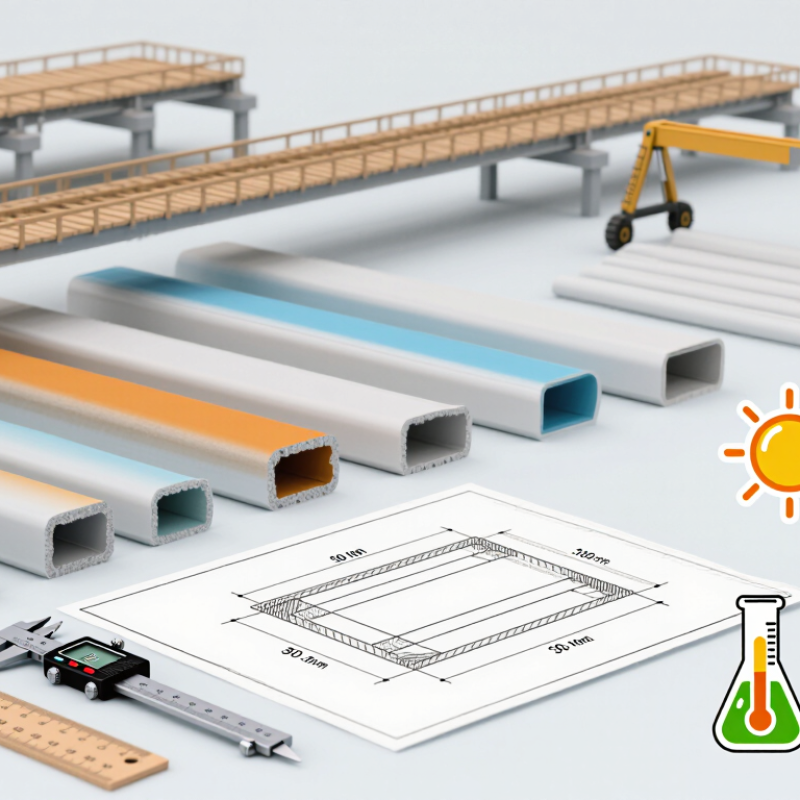
How to Choose FRP Rectangular Tubes in 2026?

Define the Structural Requirements and Intended Use

Before comparing FRP rectangular tubes, define what the member must do. Is it a handrail post, equipment frame, platform beam, or cable tray support? Each use creates different loads and support conditions. Note the clear span, load direction, and whether forces are steady, moving, or occasional. Small details matter.

A 100-by-50-millimeter tube can behave differently when its wide face is oriented vertically. Dimensions alone do not confirm suitability. Check the required strength and allowable deflection, then compare them with verified section properties and test data. A beam may carry the load yet flex enough to cause problems. That is easy to overlook.

Describe the environment, too. Outdoor sunlight, standing water, salt spray, cleaning chemicals, and temperature changes can affect service life. Record likely exposure instead of relying on a vague “weather-resistant” label. Connections deserve equal attention: bolt locations, hole sizes, bearing areas, and local crushing can govern performance. Ask for relevant material data, installation guidance, and any limits on cutting or drilling. When loads, spans, or consequences of failure are uncertain, have a qualified structural professional review the assumptions. A tidy spreadsheet is not the structure.


Compare FRP Materials, Fiber Types, and Manufacturing Methods

FRP rectangular tubes differ by resin, reinforcement and process. Polyester is economical for dry, low-corrosion settings; vinyl ester often suits harsher chemical exposure. Epoxy can offer strong bonding, but may cost more. Check the actual service temperature and chemical conditions. Small details matter.

Glass fiber is a practical choice for general structural duty. Carbon fiber offers higher stiffness at greater cost, while basalt may suit some heat or corrosion requirements. ACI 440.1R-15 reports typical GFRP reinforcing-bar elastic moduli of about 35–51 GPa. Treat this as a comparison point, not a tube specification: laminate architecture changes performance. Pultrusion suits straight, constant-section tubes and aligns fibers along the length, but corners and transverse strength need attention. Filament winding allows different fiber orientations, though rectangular shapes can be harder to produce consistently. Hand lay-up offers flexibility, yet quality may vary more between parts. That trade-off is easy to miss. Ask suppliers for test data on the finished tube, including flexural strength, water absorption and dimensional tolerances. A published fiber value alone is not enough.

How to Choose FRP Rectangular Tubes in 2026? Compare FRP Materials, Fiber Types, and Manufacturing Methods

How to read this chart: The bars show representative tensile modulus values for fibers commonly used in composites. Typical values are approximately 72 GPa for E-glass, 240 GPa for standard-modulus carbon fiber, 100 GPa for aramid, and 90 GPa for basalt fiber. Actual values vary by grade and test method; these are fiber properties, not finished-tube properties.

For pultruded FRP rectangular tubes, continuous fibers and a constant cross-section make pultrusion a common choice. Filament winding can tailor fiber direction for specific load paths, while hand lay-up is generally more dependent on workmanship. Compare the tube’s complete laminate, dimensions, load direction, environment, and verified design data—not fiber modulus alone.

Select Tube Dimensions, Wall Thickness, and Load Capacity

How to Choose FRP Rectangular Tubes in 2026?

Choosing an FRP rectangular tube starts with the job, not a catalog size. Measure the clear span, support spacing, and direction of the expected load. A 100 × 50 mm tube behaves differently when its 100 mm side is vertical. Check actual dimensions and tolerances; small differences can affect fit and stiffness. Measure twice.

Wall thickness matters, but it does not determine capacity alone. Fiber orientation, material layup, span, support conditions, and temperature also affect performance. Ask for load and deflection data that matches the tube size and installation. Compare expected loads with the stated allowable values, not just ultimate strength. A long platform rail may feel too flexible well before it breaks. That matters.

Connections deserve attention, too. Bolts, drilled holes, and clamping points can concentrate stress, so check whether the proposed detail is covered by the supplier’s guidance. Where loads are uncertain, have a qualified engineer review the design. A thicker wall may help, but it can add weight without solving a poor support layout. One judgment call remains: choosing a comfortable stiffness limit for the actual use. If the data does not match your span or loading, do not guess.

Assess Environmental Exposure, Durability, and Compliance Needs

Environmental exposure should shape the tube specification before dimensions are finalized. Record the actual conditions: salt spray near a shoreline, standing water, cleaning chemicals, freeze-thaw cycles, or direct afternoon sun. Resin type, fiber content, surface veil, and UV protection affect performance. FRP resists many corrosive environments, but it is not immune to moisture, heat, or chemical attack. Small details matter.

The AMPP/NACE IMPACT study estimated global corrosion costs at US$2.5 trillion annually, or 3.4% of global GDP. That figure covers many industries, not FRP products alone, but it shows why exposure planning matters. Ask suppliers for test data matching the intended environment, including chemical compatibility and retained mechanical properties after conditioning. I would not rely on a generic “corrosion-resistant” claim; the exact resin and exposure conditions matter.

Durability also depends on loads, temperature, support spacing, and connection design. A tube that performs well in a short test may still creep under constant load. For compliance, check dimensional tolerances against ASTM D3917 and identify required mechanical or fire tests in the project specification. ASTM E84 results, for example, do not automatically establish acceptance under every building code. Ask for evidence. Keep batch records and inspect cut edges, holes, and joints, where water can enter. Some specifications are still vague; clarify them before purchase.

Verify Product Quality, Supplier Data, and Installation Compatibility

How to Choose FRP Rectangular Tubes in 2026?

Start with the drawing, not the catalogue. Check outside dimensions, wall thickness, corner radius, and straightness against your project’s actual load and connection details. ACI 440.1R-15 reports tensile strengths of about 483–1,600 MPa and elastic moduli of 35–51 GPa for GFRP reinforcing bars. These figures are a useful materials reference, not tube design values. Tube performance depends on its fiber direction, resin system, and section geometry. Do not transfer bar data directly to a rectangular profile.

Ask suppliers for lot-specific test reports, including flexural strength, tensile properties, and water absorption. ASTM D3917 covers dimensional tolerances for pultruded FRP shapes; compare its relevant limits with the supplier’s stated tolerances and your drawings. Request the test method, specimen orientation, and production lot number. A polished certificate without traceable details is weak evidence. Small mismatch. It can still matter.

Check installation compatibility before ordering. Confirm that brackets fit the corner radii and that fastener holes leave enough material around each edge. Dry-fit a sample with the actual bolts and washers, then inspect for crushing, splitting, or unexpected movement. One detail gets missed. Saw-cut ends may expose fibers, so ask how the manufacturer recommends sealing them. Also compare the tube’s temperature range and expected deflection with site conditions; a profile that fits the drawing may still feel too flexible in service.

How to Choose FRP Rectangular Tubes in 2026? - Verify Product Quality, Supplier Data, and Installation Compatibility

Selection Dimension What to Verify Useful Data or Test Method Installation Check
Tube dimensions and tolerances Confirm outside width and height, wall thickness, corner geometry, length, and whether the profile is pultruded. Request a dimensioned drawing and stated tolerances for the exact profile. Compare measured samples and inspection records with the purchase drawing. ASTM D3917 covers dimensional tolerances for thermosetting pultruded FRP rods, bars, shapes, and sheets. Check fit within brackets, slots, sleeves, and connection details. Allow for specified tolerances, coatings, and any machining or finishing.
Structural performance Request design values that match the tube’s profile, laminate, loading direction, support conditions, and intended service. Do not treat a single strength value as a complete design rating. Ask for test reports identifying specimen dimensions, conditioning, test direction, and method. ASTM D3039/D3039M is used for tensile properties of polymer-matrix composite materials; ASTM D790 covers flexural properties of plastics, including reinforced plastics. Check the project load cases, span, connection details, and allowable deflection with the responsible designer. Confirm whether loads act along or across the pultrusion direction.
Wall quality and consistency Inspect cut ends and accessible surfaces for cracks, delamination, exposed or dry reinforcement, voids, resin-rich areas, and inconsistent wall thickness. Agree on visual acceptance criteria before ordering. Request batch inspection records and traceability linking the delivered lot to its production and inspection documentation. A sample inspection should use the agreed drawing and acceptance criteria. Keep drilled holes and cut edges within approved details. Use suitable finishing and sealing procedures where the design or exposure conditions require them.
Resin and environmental exposure Identify the resin system and verify suitability for the actual chemicals, moisture, temperature range, and outdoor exposure. “FRP” alone does not define chemical or temperature resistance. Request written exposure limits and supporting test or application data for the specific resin and laminate. Verify any stated temperature limits against the expected continuous and intermittent service conditions. Check compatibility with sealants, cleaners, coatings, and adjacent materials. For outdoor use, confirm whether a UV-resistant surface or additional protective coating is specified.
Supplier data and documentation Request a current technical data sheet, profile drawing, material identification, lot or batch traceability, inspection records, and written confirmation of any project-specific requirements. Test reports should state the test method, date, specimen details, results, and applicable acceptance criteria. If ISO 9001 certification is claimed, verify its scope and validity; it is a quality-management-system certification, not proof that a particular tube meets a design requirement. Confirm that the supplied revision, profile, and material match the approved submittal and purchase documents before fabrication or installation.
Connections and fasteners Confirm the proposed joint type, fastener material, hole size, edge distance, washer or bearing details, and any required inserts or plates. FRP connection capacity depends on the specific geometry and loading. Request connection design data or project-specific calculations where required. ASTM D2344/D2344M measures short-beam strength of polymer-matrix composite materials but does not, by itself, establish a connection design capacity. Follow the approved drilling and fastening procedure. Avoid unapproved over-tightening, unsupported bearing, or field changes that could damage fibers or reduce the designed edge distance.
Thermal movement and fit-up Request the coefficient of thermal expansion for the relevant profile direction when temperature variation could affect alignment or joint movement. Use supplier data for the specified laminate and direction; FRP expansion can differ by direction and construction. Calculate movement using the project temperature range and member length rather than assuming a universal value. Check expansion gaps, sliding supports, and alignment at operating temperatures. Confirm that sealants and connection details can accommodate the specified movement.
Electrical and fire requirements Where relevant, verify electrical insulation requirements and the fire-performance criteria required by the project or applicable regulations. Properties vary with resin, reinforcement, additives, and laminate construction. Request test reports against the exact specified standard and rating. Do not infer electrical or fire performance from appearance or from a generic FRP description. Confirm required clearances, grounding or bonding approach, and fire-protection details with the project specification and applicable code requirements.

Selection note: Treat supplier values as applicable only to the documented profile, material, test direction, and conditions. Final sizing, connections, and installation details should be checked against the project requirements by a qualified designer.

Start WhatsApp Chat Start WhatsApp Chat
Valves

Valves

Water Meters

MS Forged Pipe Fittings

Fittings

Water Meters

Valves

DI Grooved Fittings (UL/FM)

Water Meters

DI Screwed Fittings (UL/FM)

Fittings

Composite Pipes & Fittings

Site Credits : Seigospace