
Choosing the right Run Capacitor is a small decision with major consequences for motor performance, efficiency, and service life. A mismatched capacitor can leave a condenser humming, overheating, or drawing unstable current. Sometimes, the failure begins with one overlooked label.
Industry research supports the importance of this component. Grand View Research and Fortune Business Insights both identify rising demand for reliable capacitors across HVAC, industrial, and appliance applications. The U.S. Department of Energy also highlights motor-system efficiency as a practical path toward reducing electricity use. These reports do not make selection simple. They show why accuracy matters.
HVAC educator Bryan Orr explains the electrical principle clearly: “A capacitor creates a phase shift; it does not simply provide extra starting power.” That distinction matters when choosing a Run Capacitor for continuous motor operation. Check the motor nameplate first. Match the rated microfarads exactly. Select equal or higher voltage, never lower. Confirm tolerance, frequency, operating temperature, terminal layout, and physical clearance. A 40/5 µF dual capacitor is not interchangeable with a 45/5 µF model merely because it fits the bracket.
Small details decide the outcome.
IEC 60252-1 provides an important reference for AC motor capacitors, while manufacturer specifications remain the final authority. A neat selection checklist can still fail in the field. Heat, vibration, aging wiring, and poor airflow may create symptoms that look like capacitor failure. The safest choice combines measured capacitance, nameplate data, documented application experience, and qualified technical judgment.
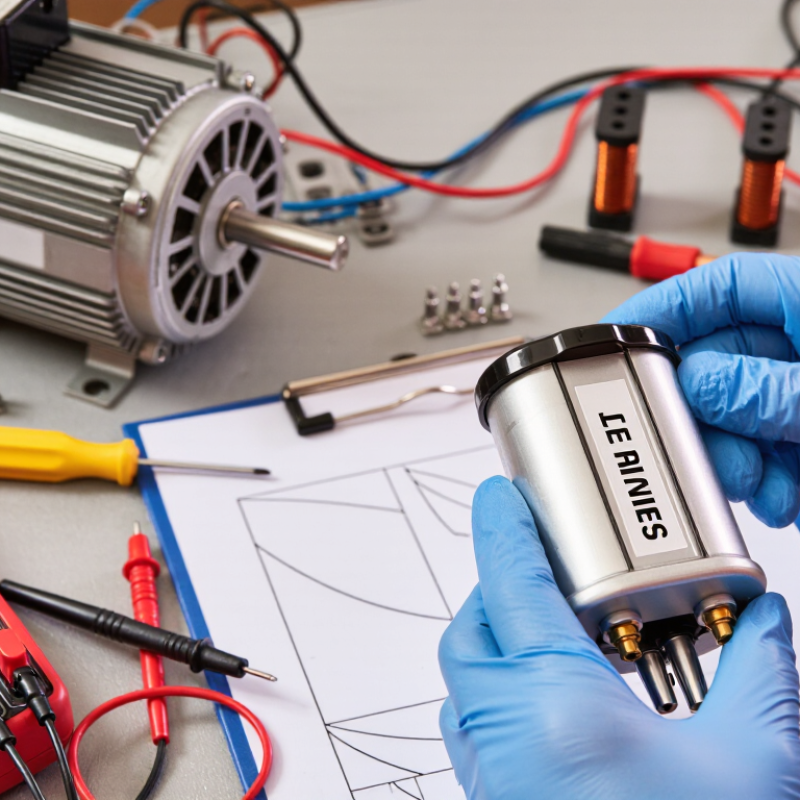
A run capacitor stays connected while a single-phase motor operates. It shifts current in the auxiliary winding. This phase difference helps create a rotating magnetic field. The motor then runs with smoother torque and improved electrical efficiency. It may also reduce humming, excess heat, and unnecessary current draw.
The correct capacitance matters. Too little capacitance can weaken performance, while too much can overheat the winding.
Check the motor’s specified microfarad value before choosing a replacement. The voltage rating should match or exceed the original component. Use an AC motor-run capacitor, not a short-term start capacitor.
Frequency, tolerance, terminal arrangement, and physical dimensions also deserve attention. A part that fits poorly may suffer vibration or loose connections. Small details matter.
A practical inspection can reveal swelling, leaking oil, cracked insulation, or burnt terminals. Humming and difficult starting may also indicate capacitor trouble. Still, visual checks are not enough. A capacitor can look normal and test poorly.
Disconnect power, verify zero voltage, and follow proper discharge procedures before touching it. I would not rely on guesswork here. Measuring capacitance with a suitable meter provides stronger evidence, although a motor fault can produce similar symptoms. A qualified technician should confirm uncertain readings.

How to Choose the Right Run Capacitor for Your Needs?
Key Specifications to Check Before Choosing a Run Capacitor
Choosing a run capacitor starts with the motor’s original specifications. Check the capacitance value, measured in microfarads (µF). Even a small mismatch can cause weak starting, overheating, or noisy operation. The rated voltage must meet or exceed the motor circuit voltage. Never treat a higher µF value as a harmless upgrade. It may increase winding stress and shorten motor life.
Look for a capacitor designed for continuous-duty operation. Confirm its AC voltage rating, frequency, tolerance, and operating temperature range. Outdoor equipment may face heat, moisture, and vibration. A durable case and secure terminals matter there. Physical size matters too. Measure the mounting space before ordering. A correct electrical rating is useless if the capacitor cannot fit safely.
Check the motor manual, wiring diagram, or the markings on the existing part. Compare the terminal layout carefully. Loose connections can create heat marks around the terminals. That detail is easy to miss. In practical inspections, technicians also check for swelling, oil leakage, cracked cases, and unusual humming. These signs suggest replacement may be necessary, but they do not prove the capacitor is the only fault. Test the capacitance with a suitable meter, disconnect power fully, and follow local electrical safety requirements. My own selection rule is conservative: match the specified capacitance, choose equal or higher voltage, and question any unexplained change.
A run capacitor must match the motor’s specified capacitance, measured in microfarads (µF). Check the nameplate or service manual before opening the housing. A 40 µF motor usually needs a 40 µF replacement, within the stated tolerance. Do not treat 35 or 45 µF as “close enough.” Higher capacitance can increase winding current and heat. Lower capacitance may reduce torque and power-factor correction. The result can be subtle at first. Then the motor hums, runs hot, or trips protection.
Voltage rating matters just as much. Select a capacitor with the same or higher AC voltage rating than the original. A 440 VAC capacitor can generally replace a 370 VAC unit when the capacitance matches. The reverse is unsafe. Confirm the system frequency, temperature range, terminal style, and continuous-duty rating.
Run capacitors differ from short-duration start capacitors. Mixing them is a common and costly mistake. The IEC 60252-1 standard defines performance and safety requirements for motor capacitors, while the U.S. Department of Energy’s Motor Systems Sourcebook reports that motor-driven equipment uses about 69% of industrial electricity. Small component errors can therefore waste meaningful energy.
A practical check is simple: photograph the label, compare every value, and inspect swelling or oil leakage. Even experienced technicians should pause here; capacitor markings and tolerance codes are surprisingly easy to misread.
Choosing the right run capacitor starts with its construction, not its label alone. In motor applications, polypropylene film is common because it offers stable capacitance and low losses. Metallized film can heal small internal faults, but that feature is not unlimited. A motor beside a hot compressor needs a capacitor rated for its real temperature. Ambient heat, airflow, and vibration all matter. I have seen a correctly sized capacitor fail early because heat was treated as an afterthought. That mistake is easy to repeat.
Compare self-healing metallized film with film-and-foil construction. Metallized designs are usually compact and lightweight. Film-and-foil designs can handle demanding current pulses, but they may need more space. Check the datasheet for operating temperature, humidity category, expected life, and voltage tolerance. Do not select by capacitance alone. The replacement should match the motor’s specified microfarads and meet its voltage rating. It must also support the correct AC frequency. Higher voltage is not always better if the case, terminals, or mounting arrangement no longer fit. Small details matter.
For outdoor or dusty equipment, choose sealed construction with secure terminals and a suitable pressure interrupter. Inspect bulging, leakage, loose terminals, or a burnt smell before reuse. Disconnect power and verify discharge with appropriate test equipment. A capacitance meter helps, but it cannot reveal every insulation defect. This is where judgment becomes imperfect. A reading may look normal while aging has reduced reliability. When the application is unclear, follow the motor documentation and consult a qualified technician before energizing the circuit.
For a 240 V, 60 Hz motor circuit, capacitive current increases linearly with capacitance: I = 2πfCV. Select the capacitance value specified by the motor manufacturer, match the required AC voltage rating, and verify the frequency, tolerance, temperature range, and terminal construction.
Metallized polypropylene film capacitors are commonly used for continuous motor-run service because they are designed for continuous AC operation. Aluminum electrolytic capacitors are generally intended for starting or DC applications and should not be substituted for a continuous AC run capacitor unless specifically approved for that duty.
How to Choose the Right Run Capacitor for Your Needs?
Before touching a run capacitor, switch off the main power and lock the disconnect. Do not trust a dark display or silent motor. Verify zero voltage with a properly rated multimeter. A capacitor can retain a dangerous charge after shutdown. Discharge it with an approved resistor tool, never by shorting the terminals with a screwdriver. Wear safety glasses, and stop if wiring looks burned, loose, or unfamiliar.
Choose the replacement by matching the motor’s required capacitance in microfarads. The voltage rating may be equal to or higher than the original, but the capacitance should stay within the manufacturer’s tolerance. Check the terminal labels, case size, mounting strap, and temperature rating. Take a clear wiring photo before removal. Mark each wire. This small step prevents expensive confusion. I have seen correct-looking capacitors installed with one misplaced lead, causing immediate motor trouble.
To test an accessible capacitor, isolate the power, discharge it safely, and remove at least one wire. Set a suitable meter to capacitance mode, then compare the reading with the label. A low reading, unstable result, swollen case, oil residue, or burned terminal signals replacement. Never rely on appearance alone. Reconnect the wires firmly to the matching terminals, secure the capacitor upright, and restore power only after checking clearances. If the meter reading is confusing, or the system uses high voltage, call a qualified electrician. My own weak habit is rushing the final inspection; a second check is worth the minute.