
Choosing the right Hdpe Floater is not simply a matter of comparing prices. Global buyers must examine buoyancy, wall thickness, ultraviolet resistance, impact strength, and connection design. A floater that performs well in calm water may struggle under waves, currents, or repeated loading. Small details matter. Poorly finished edges can damage ropes. Weak welds may allow water ingress. Inconsistent dimensions can also complicate installation.
Dr. Robert M. Koerner, a respected geosynthetics engineer, stated, “The primary function of a geosynthetic is to improve the performance of a structure.” This principle applies to floating systems too. A reliable Hdpe Floater should support the complete structure, not merely remain on the water. Buyers should request material data, production tolerances, load results, and field references before selecting a supplier. They should also check whether the manufacturer understands local weather, transport conditions, and maintenance needs.
This guide reviews seven Hdpe Floater options for international buyers. Each option is considered through practical criteria, including flotation stability, fabrication quality, modularity, service life, and supplier support. The ranking is useful, but not absolute. Project conditions can change the result. A premium model may be unnecessary for a sheltered pond, while a cheaper product may fail quickly in exposed coastal water. That is the difficult part. Product pages often show clean surfaces and perfect installations. Real sites are less forgiving. Therefore, buyers should treat specifications as evidence, not promises, and confirm performance through independent testing whenever possible.
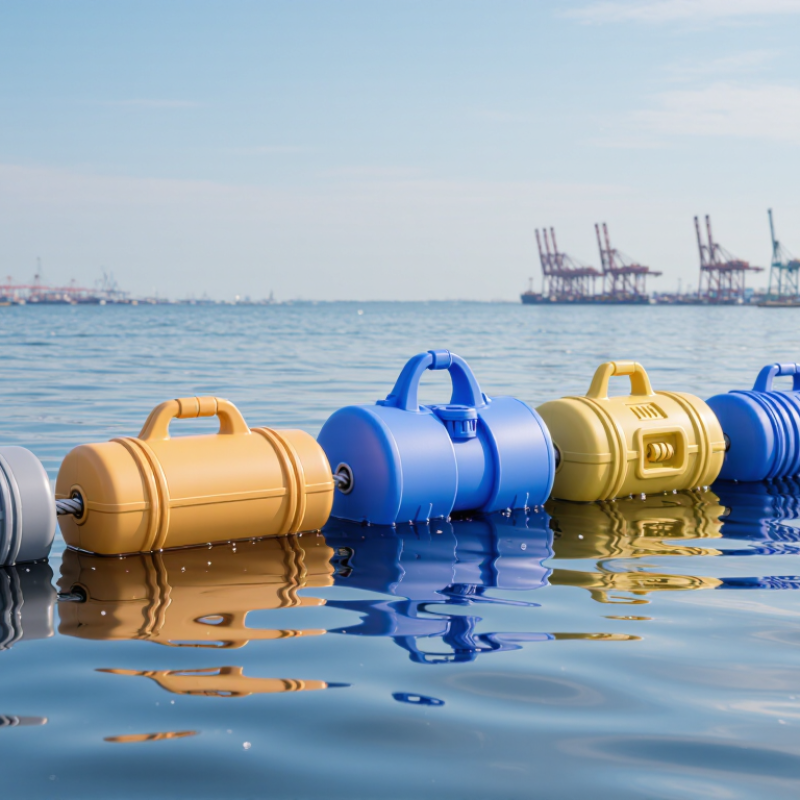
7 Best HDPE Floaters for Global Buyers?
HDPE floaters are hollow, rotationally molded or extruded units that support docks, walkways, pipes, and aquaculture equipment. They work through displacement: the floater pushes water downward, while buoyant force pushes the structure upward. The physics is simple.
ASTM D792 commonly measures HDPE density near 0.94–0.97 g/cm³, below freshwater at about 1.00 g/cm³. A sealed 1 m³ chamber can therefore displace nearly 1,000 kilograms of water. Its actual lifting capacity is lower after subtracting HDPE walls, connectors, and safety reserve. A 0.95 m³ plastic shell weighing 80 kilograms may provide roughly 870 kilograms of gross support in freshwater, before waves and payloads.
The seven most useful floater types usually include modular cubes, cylindrical pipe floats, pontoon blocks, raft collars, dock drums, cable floats, and custom chambers. Selection depends on freeboard, impact exposure, water salinity, and connection loads. The OECD Global Plastics Outlook reports 460 million tonnes of plastic waste generated globally in 2019, so durability and end-of-life planning deserve attention. Recyclability claims still need verification.
Field experience shows that UV exposure, abrasion, trapped water, and poorly sealed fittings cause many failures. Closed-cell designs limit flooding, but they do not eliminate it. Inspect welds and fasteners regularly. Performance also changes with temperature, current, and uneven loading. This part is often underestimated. Calculations should follow local engineering requirements and tested load data, not catalogue buoyancy alone.

HDPE floaters are hollow, sealed polyethylene structures that displace water and create upward buoyant force. The chart compares seven common floater formats using engineering estimates based on freshwater and seawater density, listed displacement volume, and estimated tare mass. Net buoyancy is calculated as displaced water mass minus floater mass.
Reference densities: freshwater ≈ 1,000 kg/m³ and seawater ≈ 1,025 kg/m³. Actual performance depends on wall thickness, welding quality, internal reinforcement, loading condition, water temperature, and safety factor.
| Floater format | Typical dimensions | Displacement volume (m³) | Estimated tare mass (kg) |
|---|---|---|---|
| Modular cube | 1.0 × 0.5 × 0.4 m | 0.200 | 18 |
| Cylindrical drum | Ø0.6 × 1.2 m | 0.339 | 28 |
| Rectangular pontoon | 2.0 × 0.5 × 0.5 m | 0.500 | 48 |
| Twin-hull float | 2 × (2.0 × 0.4 × 0.4 m) | 0.640 | 70 |
| Ring float | Ø1.2 / Ø0.6 × 0.25 m | 0.212 | 20 |
| Pipe float | Ø0.4 × 2.0 m | 0.251 | 22 |
| Spherical buoy | Ø0.8 m | 0.268 | 25 |
Seven Leading HDPE Floater Types for Global Buyers
HDPE floaters serve marinas, aquaculture sites, work platforms, and temporary access routes. The seven leading types include modular cubes, pontoon blocks, cylindrical drums, pipe floats, swim-platform units, cable floats, and heavy-duty utility pontoons. Modular cubes suit flexible layouts, while pontoon blocks provide steadier walking surfaces. Cylindrical drums work well beneath narrow platforms. Pipe floats support long pipelines and hoses. Swim-platform units prioritize comfort and edge safety. Cable floats keep marine lines visible. Utility pontoons carry tools, pumps, and light equipment.
According to Grand View Research, the global HDPE market was valued at about USD 80.55 billion in 2023. That scale supports broad material availability and replacement access. The OECD Global Plastics Outlook reported global plastics production reached 460 million tonnes in 2019. Buyers should therefore request UV stabilization, resin specifications, and recycling information. Material volume alone does not prove durability. It is an easy mistake.
In practical inspections, I check weld seams, connector holes, buoyancy loss, and surface cracking before installation. A floater may look strong but fail under uneven loading or sharp contact. Published load ratings need real installation conditions, including waves, wind, equipment weight, and maintenance traffic. High-density polyethylene resists corrosion, yet sunlight and abrasion still matter. Choosing the cheapest unit can increase replacement frequency. Ask for test records, dimensional tolerances, and a clear warranty scope. The best selection balances buoyancy, handling, repairability, and local operating conditions.
High-quality HDPE floaters begin with reliable material selection. Virgin or certified-grade HDPE should resist cracking, saltwater, oils, and repeated impact. Its density is typically below 1.0 g/cm³, supporting strong buoyancy when the structure is sealed correctly. However, resin quality alone is not enough. Wall thickness, internal ribs, and heat-welded seams determine real service performance.
UV protection matters in exposed marinas, aquaculture sites, and offshore work areas. Look for UV-stabilized material and documented weathering tests, such as ISO 4892-3 procedures. A floater should also include reinforced connection points, smooth edges, and replaceable hardware. Small details matter. Poorly positioned bolts can create stress cracks after months of wave movement.
The OECD Global Plastics Outlook reported 353 million tonnes of plastic waste in 2019, while only 9% was recycled. This strengthens the case for durable, repairable HDPE products with clear recycling information. Buyers should request load tests, buoyancy calculations, impact data, and production traceability. Ask for evidence, not promises. A lower-cost floater may look excellent on delivery day, yet hidden voids or weak welds can shorten its working life. I would also question recycled-content claims unless certificates identify the source and percentage. Perfect specifications do not guarantee perfect installation.
Compare HDPE floaters by use before comparing price. An aquaculture walkway needs stability, easy cleaning, and resistance to constant wetting. A floating solar platform needs higher stiffness, controlled deflection, and reliable cable protection. Service docks also face repeated impacts from boats and lifting equipment. The suitable design depends on daily loading, not advertised capacity.
Load calculations should include people, equipment, wave action, wind, current, and mooring forces. ISO 1183-1 testing commonly places HDPE density near 0.941–0.965 g/cm³. In freshwater, one cubic metre can theoretically provide about 35–59 kilograms of net buoyancy before structure and safety allowances. Seawater improves this figure because its density is roughly 1,025 kg/m³. Do not treat it as usable capacity. A prudent design reserves freeboard and emergency buoyancy.
Environment changes the choice. Ultraviolet exposure can embrittle poorly stabilized surfaces, while salt, sand, ice, and temperature cycling accelerate wear. PIANC Report 153 recommends reviewing wave, current, mooring, fatigue, and maintenance conditions together. ASTM D792 or ISO 1183-1 density checks can support incoming material verification. Field inspection still matters. One sample cannot represent every production batch. A neat spreadsheet can also mislead when impact loads are missing.
7 Best HDPE Floaters for Global Buyers?
Global buyers should judge HDPE floaters by application, not appearance alone. A stable floater needs verified buoyancy, wall thickness, UV resistance, and impact performance. Ask for material certificates, load calculations, and production inspection records. Applicable regional standards may differ, so confirm requirements before placing an order. Do not assume one certificate covers every market.
Customization can improve performance when handled carefully. Suppliers may adjust dimensions, connector positions, colors, chambers, and ballast spaces. However, larger units can create greater stress at connection points. Request engineering drawings, prototype testing, and a clear tolerance range. I have found that attractive samples sometimes hide weak welds or inconsistent thickness. That detail deserves attention.
Tips: Compare at least three suppliers using the same specification sheet. Check manufacturing experience, mold quality, traceability, inspection procedures, and replacement support. Ask whether the supplier has completed similar marine or floating-platform projects. A factory visit or live video inspection can reveal storage conditions and process discipline. Request a sample, but test it under realistic load and water exposure. Cheap pricing is tempting. It may reduce long-term reliability. Also clarify packaging, spare connectors, delivery terms, and warranty limits in writing. A careful supplier should explain limitations, not promise everything.
| Rank | HDPE Floater Type | Typical Application | Indicative Dimensions | Indicative Buoyancy | Recommended Material and Construction | Customization Options | Relevant Quality Checks and Standards | Global Buying Advantages |
|---|---|---|---|---|---|---|---|---|
| 01 | Modular Cube Pontoon Floater | Floating walkways, marina fingers, recreational platforms, temporary event docks | 500 × 500 × 400 mm or 1,000 × 500 × 400 mm modules | Approximately 90–170 kg gross buoyancy per module before deducting structure, fittings, and safety reserve | UV-stabilized rotational-molded HDPE; hollow double-wall body; molded anti-slip surface; stainless-steel or hot-dip-galvanized connection hardware | Module size, connector pattern, deck texture, color, cleats, rollers, handrails, access ramps, and service openings | HDPE material verification to ASTM D4976 or ISO 1872-1; tensile testing to ASTM D638; UV exposure testing to ASTM G154 or ISO 4892-3; leak and load testing | Easy to transport and replace; scalable layout; compatible with different walkway widths; suitable for phased installation |
| 02 | Cylindrical HDPE Pontoon | Boat docks, floating bridges, aquaculture service platforms, utility pontoons | Diameter 400–1,200 mm; length 2–12 m | Approximate theoretical displacement of 125–1,130 kg per metre, depending on diameter; working capacity must include reserve buoyancy | Extruded or rotational-molded HDPE shell; sealed end caps; internal bulkheads or foam-assisted safety compartments where required | Diameter, length, wall thickness, ballast chambers, brackets, towing points, protective wear strips, and joining arrangement | Dimensional inspection; hydrostatic leak test; weld inspection where applicable; impact testing to ASTM D256; UV-stabilizer verification; project-specific structural calculations | Efficient buoyancy-to-weight ratio; good resistance to salt water and many chemicals; suitable for long linear structures |
| 03 | Rectangular Dock Float | Residential and commercial floating docks, swimming platforms, fishing piers, marina extensions | 1,000–3,000 mm long × 500–1,500 mm wide × 300–600 mm high | Typically 150–2,500 kg gross displacement per unit, depending on volume and immersion depth | Rotational-molded HDPE with reinforced ribs, closed-cell internal structure or sealed cavity, molded mounting points, and replaceable wear components | Freeboard, deck height, anti-slip finish, connection holes, corner protection, access hatches, colors, and load distribution layout | Floatation and stability calculations; compression and flexural tests to ASTM D695 and ASTM D790; water-tightness inspection; salt-spray evaluation for metal fittings | Stable rectangular geometry; straightforward engineering calculations; broad compatibility with timber, aluminum, and composite decking |
| 04 | HDPE Pipe Floater | Floating pipelines, dredging lines, slurry transfer systems, temporary marine hoses, intake and discharge lines | For pipe outside diameters of approximately 160–1,200 mm; float length commonly 1–6 m | Designed to provide positive buoyancy for the pipe, contents, couplings, and accessories; project capacity is calculated from total submerged weight | Clamshell or saddle-type HDPE float with stainless-steel, polymer, or coated-metal straps; rounded edges to reduce line abrasion | Pipe diameter, clamp geometry, spacing, hinge design, strap type, drain plugs, ballast pockets, and towing attachments | Compatibility with the pipe system; HDPE material testing to ISO 1872-1; strap tensile testing; flotation calculation at maximum filled weight; abrasion and cyclic-load assessment | Fast installation and relocation; adaptable to different pipe diameters; useful for short-term or changing marine projects |
| 05 | Aquaculture Cage Floater | Fish cages, shellfish farms, hatchery platforms, feeding and inspection walkways | Ring diameter 10–40 m; individual float modules commonly 2–6 m long | Project-specific; normally engineered for cage net load, walkways, feed systems, waves, current, and storm reserve | UV-stabilized HDPE pipe or molded sections; heat-fused joints where suitable; corrosion-resistant fittings; replaceable brackets and access points | Ring diameter, pipe diameter, net attachment points, walkway supports, feed-line brackets, guardrails, mooring eyes, and service platforms | UV resistance to ASTM G154 or ISO 4892-3; weld qualification for butt-fused or extrusion-welded joints; buoyancy and fatigue assessment; marine corrosion review | Low corrosion risk in seawater; modular repairability; good resistance to biological fouling impacts and repeated wetting cycles |
| 06 | Floating Pipeline Support Floater | Water intake lines, irrigation systems, mining-water lines, environmental remediation, and offshore transfer lines | Custom support length 1–8 m; pipe support diameter and spacing determined by line size and operating condition | Must maintain positive buoyancy with the pipeline empty, partially filled, and fully filled; recommended design includes a project-defined reserve margin | Heavy-duty HDPE body with high-impact ribs, independent fastening system, drainage provisions, and replaceable contact pads | Pipe diameter, support spacing, anchor points, ballast, cable guides, non-abrasive liners, and coupling arrangement | Load testing under filled-pipe conditions; impact testing; fastening-cycle inspection; hydrostatic stability review; chemical compatibility assessment for the transported medium | Suitable for freshwater and many industrial environments; simple maintenance; adaptable to irregular shore-to-shore routing |
| 07 | Heavy-Duty Work Platform Floater | Construction barges, inspection platforms, maintenance pontoons, emergency access platforms, and utility work decks | Typical platform modules 2,000–6,000 mm long × 1,000–3,000 mm wide × 400–800 mm high | Approximately 0.8–4.0 tonnes gross displacement per module, subject to geometry, immersion, and stability requirements | Thick-wall HDPE shell with reinforced internal ribs or sealed chambers; engineered steel or aluminum frame; high-friction deck surface | Deck load rating, lifting lugs, crane pockets, gangways, bollards, guardrails, equipment mounts, ballast tanks, and modular connectors | Structural design review; flexural testing to ASTM D790; compressive testing to ASTM D695; dimensional tolerance inspection; load, stability, and lifting-point verification | High customization potential; reusable across projects; good resistance to impact, moisture, and many common marine chemicals |